
How to Troubleshoot Rapid Cycling and Prevent Mid-Winter Heating Failures
When winter temperatures plunge across Massachusetts, your heating system should cycle predictably to maintain even indoor comfort. If your furnace ignites, runs for only two to five minutes, and abruptly shuts down before warming your home, your system is short-cycling.
A furnace is short-cycling when it repeatedly shuts down within 2 to 5 minutes without reaching your thermostat temperature setpoint. In Greater Boston homes, this is most commonly caused by restricted airflow overheating the primary limit switch, carbon buildup on the flame sensor rod, a clogged condensate drain on condensing units, or an oversized heating system. While homeowners can safely replace filters and unblock registers, ongoing short-cycling strains blower motors, spikes heating bills, and risks cracked heat exchangers.
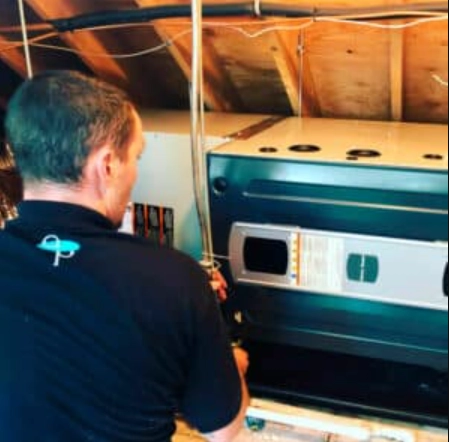
Licensed technicians inspect airflow pathways, combustion limit switches, and flame sensors to restore reliable heating cycles.
1. Restricted Airflow and Overheating Primary Limit Switches
The single most common culprit behind furnace short-cycling is restricted airflow across the heat exchanger. When a furnace cannot pull sufficient cool return air through a heavily loaded 1-inch or 4-inch pleated filter, thermal energy rapidly accumulates inside the heat chamber. As plenum temperatures surpass safe thresholds (typically 180°F to 200°F), the high-limit safety switch trips to protect against fire, instantly cutting fuel to the burners while keeping the blower fan running.
Once internal temperatures normalize, the limit switch resets and the burners fire again, only to overheat minutes later. Beyond clogged air filters, closed supply registers, furniture obstructing return grilles, or undersized ductwork create excessive static pressure that traps high-temperature air inside the unit.
2. Dirty or Corroded Flame Sensor (Combustion Safety Lockout)
Modern gas furnaces rely on flame rectification to confirm that burners have successfully ignited. The flame sensor is a thin metallic rod situated directly in the burner flame path. When burners fire, the integrated furnace control board (IFC) delivers an alternating current (AC) signal through the sensor rod; the burning gas converts this signal into direct current (DC) microamps that confirm combustion to the board.
Over months of heating operation, airborne particulates and combustion byproducts create an invisible layer of carbon oxidation on the sensor surface. Unable to detect the required microamp current, the control board assumes ignition failed and shuts the gas valve off within 3 to 7 seconds to prevent explosive raw gas buildup.
3. Blocked Flue Exhaust, Intake Pipes, and Clogged Condensate Traps
High-efficiency condensing furnaces extract heat until combustion gases cool and condense into acidic water vapor. If the internal condensate drain trap, collector box, or drain hose clogs with scale or algae, drainage backs up inside the heat exchanger. This triggers the differential air pressure switch, immediately interrupting the heating sequence.
Exterior venting blockages cause an identical shutdown. During prolonged Massachusetts freeze cycles, drifting snow, icicles, or autumn leaves can obstruct exterior PVC flue exhausts and combustion air intake pipes. The inducer fan pressure switch detects insufficient draft and prevents burner operation to avoid venting carbon monoxide into the dwelling.
4. Thermostat Calibration, Battery Failure, or Poor Placement
Short-cycling is not always an internal mechanical problem; a malfunctioning thermostat can command premature shutdowns. Weak AA alkaline batteries often cause digital thermostats to misread ambient temperatures, cycling the furnace off before living areas warm up.
Physical placement is equally critical. If a thermostat is installed directly in the path of a warm supply register, near high-heat kitchen appliances, or in direct sunlight, the sensor warms up artificially fast and terminates the heating call while the rest of the house remains freezing cold. Verifying stable 24V C-wire voltage and checking thermostat calibration eliminates false cycling commands.
5. Equipment Sizing Imbalances: When an Oversized Furnace Cycles Rapidly
If a furnace has short-cycled since the day it was installed, it is frequently oversized for the square footage of the home. Heating contractors who fail to perform accurate Manual J load calculations may install a unit with excessive BTU output. An oversized furnace delivers an intense blast of hot air that satisfies the thermostat in minutes, shutting down before heat can circulate evenly.
This constant rapid thermal cycling leaves exterior rooms cold, fails to regulate indoor winter humidity, and subjects the heat exchanger to repeated expansion and contraction stress that shortens equipment lifespan.
Safety and DIY Limits: What You Can Safely Check vs. Calling a Licensed Pro
Because residential gas and oil furnaces involve high voltage electrical connections, combustible fuel lines, and carbon monoxide exhaust pathways, homeowner troubleshooting must strictly follow safety boundaries.
Safe Homeowner Checklist (DIY)
- Replace Air Filter: Swap loaded 1-inch or 4-inch filters for a clean MERV 8–11 pleated filter.
- Check Vents & Grilles: Ensure all supply registers and return air grilles are open and unobstructed.
- Verify Thermostat: Install fresh alkaline batteries; ensure switch is set to “HEAT” and fan set to “AUTO”.
- Clear Exterior Pipes: Clear snow, ice, or autumn leaves from outside PVC intake and exhaust termination pipes.
When to Call a Licensed Pro (Hazardous)
- Gas Valves & Burners: Never attempt to disassemble gas manifolds, adjust fuel pressure, or service burner jets.
- Flame Sensors & Control Boards: Testing DC microamps or diagnosing 120V/24V circuit boards requires certified diagnostic meters.
- Heat Exchanger Inspection: Thermal stress can cause hairline cracks that leak deadly Carbon Monoxide (CO).
- Tripping Limit Switches: Never bypass or jumper safety switches; repeated trips indicate dangerous internal overheating.
Per the National Fuel Gas Code (NFPA 54) and the Massachusetts State Building Code (780 CMR), combustion diagnostics, mechanical safety switch replacements, and gas line servicing must be performed by certified, licensed HVAC contractors to protect household health and life safety.
Expert Furnace Diagnostics & Heating Repair Across Greater Boston
For over 9 years, Akian Plumbing, Heating, Cooling & Electric has delivered institutional-grade mechanical craftsmanship and dependable home heating solutions across Middlesex, Suffolk, and Norfolk Counties. Led by founder Stephen S. Akian, CPD (Certified in Plumbing Design, Master Plumber License #PL16320-M), our licensed technicians specialize in root-cause diagnostics that eliminate short-cycling and protect your heat exchanger from premature winter failure.
When you schedule a diagnostic inspection, our technicians perform precision microamp testing, static duct pressure evaluation, combustion flue analysis, and heat exchanger camera scans to ensure your furnace runs efficiently throughout prolonged New England winter freezes.
Need fast local emergency service? For homeowners in Middlesex County experiencing furnace short-cycling or burner lockouts, Akian provides same-day heating and boiler repair in Arlington, MA with 24/7 mobile dispatch.
Call (617) 458-8189Explore Professional Furnace Repair Services
Frequently Asked Questions About Furnace Short-Cycling
Why does my furnace shut off after only 2 to 3 minutes?
Shutting down after just 2 to 3 minutes typically means an automatic safety limit switch has tripped. The most frequent triggers are a heavily clogged air filter causing the heat exchanger to overheat, a carbon-coated flame sensor failing to detect combustion, or a clogged condensate trap on high-efficiency condensing furnaces.
Is it dangerous to let a furnace continue short-cycling?
Yes. Repeated short-cycling places extreme mechanical stress on the blower motor, draft inducer, and igniter, leading to premature component failure. More critically, repeated thermal cycling can crack the internal heat exchanger, creating a severe risk of carbon monoxide venting into living spaces.
Can a faulty or dead-battery thermostat cause furnace short-cycling?
Yes. Weak batteries, loose 24V thermostat wiring, improper anticipator settings, or a thermostat mounted in direct sunlight or directly opposite a supply air register can register false heat spikes and shut the burner off prematurely.
How can I tell if my furnace is short-cycling versus running a normal heating cycle?
A healthy heating cycle runs continuously for 10 to 20 minutes to evenly warm the living space to the thermostat target. If your furnace runs for less than 5 minutes and turns on and off 4 to 8 times an hour without reaching temperature, it is short-cycling.
Fill out the form below or call our 24/7 priority line at (617) 458-8189 for immediate dispatch.